 admin
Fast Facts About The WisdomTree Cloud Computing Fund ETF
The WisdomTree Cloud Computing Fund ETF (WCLD) was launched on September 6, 2019, and tracks the BVP Nasdaq Emerging Cloud Index. WCLD has a portfolio of 64 stocks and an expense ratio of 0.45%. It doesn’t pay distributions. It is a relatively small but liquid ETF, with $304 million in assets under management and an average daily volume of $27 million. These numbers mean about 9% of AUM changes hands every day on average and signal notable trading activity. The sponsor, WisdomTree (WT), is an ETF provider and asset management company with over $160 billion in total AUM. It also offers investment advisory services.
WCLD’s Strategy
As described by WisdomTree, the underlying index targets US-listed companies that meet the following two criteria:
- Offer business-oriented software products through a browser, mobile device, or application programming interface (“API”).
- Have a subscription-based, volume-based, or transaction-based offering.
Eligible companies must:
- Derive at least 50% of their revenue from the cloud business.
- Have a revenue growth rate of at least 7% in at least one of the last two fiscal years (15% each year for new constituents).
- Have at least $500 million in market capitalization.
- Have at least $5 million in 3-month average daily trading volume.
- Meet environmental, social, and governance (“ESG”) criteria.
The index is equal-weighted and reconstituted semi-annually. The portfolio’s turnover rate was 43% in the most recent fiscal year. I will use the State Street Technology Select Sector SPDR ETF (XLK) as a benchmark.
Portfolio
The portfolio composition is an example as of November 12, 2026. Weights and metrics may have changed by the time you read this.
WCLD is mostly invested in mid-, small-, and micro-caps (about 87% of asset value) in information technology (92%), with a few companies in other sectors (healthcare, industrials, and financials). At the subsector level, the software industry is leading (79%).
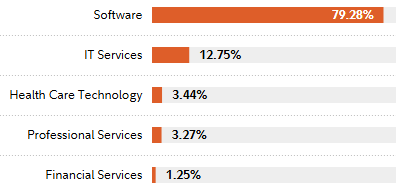
WCLD industry breakdown (Fidelity)
Company-specific risk is low due to the equal-weight methodology. The top 10 holdings, listed in the next table, represent 20% of asset value, and the largest position weighs 2.3%. These are the constituents with the highest price return since the most recent rebalance.
Fundamentals
WCLD is significantly cheaper than XLK based on price/book, price/sales, and price/cash flow, but P/E is higher, as reported in the table below. It also shows higher sales and cash flow growth rates. Earnings growth is undefined, likely because prior aggregate earnings were negative or close to zero. As earnings are now positive (based on P/E), this signals real earnings growth.
To summarize, WCLD combines growth and value characteristics within the tech sector, despite a high P/E.
Data: Fidelity
Performance
WCLD has underperformed XLK by 16.6% annualized from September 13, 2019 to November 12, 2026, with a much deeper maximum drawdown and higher volatility.
Data: Portfolio123
It is 2.6% behind the sector benchmark over the 12 months before November 12, 2026.
Fear that AI models may replace many IT services and business software products is the main driver of the cloud computing segment’s underperformance.
Competitors
The next table compares characteristics of WCLD and three other cloud computing ETFs:
- First Trust Cloud Computing ETF (SKYY)
- Global X Cloud Computing ETF (CLOU)
- Fidelity Cloud Computing ETF (FCLD)
I excluded the Themes Cloud Computing ETF (CLOD) from the peer comparison because of its very low AUM ($3 million) and lack of liquidity ($33K daily average).
Data: Seeking Alpha
WCLD is the least concentrated in its top holdings. It ranks last in 5-year return, but second over the past 12 months. What makes WCLD unique is its equal-weight underlying index. SKYY is weighted based on a theme-strength score, while CLOU and FCLD have modified market-cap weighting schemes.
Takeaway: who should consider WCLD?
WCLD offers equal-weight exposure in US-listed cloud computing companies meeting certain requirements. Over the past few years, cloud computing stocks have suffered from the competition of AI models (or the sentiment about it). WCLD is well-suited for tactical allocation and swing trading, but its choppy track record is uncompelling for a long-term position.
- Pros: unique equal-weight ETF in the theme, solid fundamental metrics within the tech sector.
- Cons: weak returns, high volatility.
This article answers these three main questions about WCLD:
- How is the WCLD portfolio structured?
- How does WCLD fare against its sector benchmark and competitors?
- What type of strategy is WCLD best suited for?
Editor’s note: This article is intended to provide a general overview of the ETF for educational purposes only and, unlike other articles on Seeking Alpha, does not offer an investment opinion about the ETF.
Read the full article here